TL;DR: RK3568 Payment Terminal OEM with Face Recognition
About AndroidSBC and the Smart Payment Terminal Android Motherboard Family
AndroidSBC builds smart payment terminal Android motherboards for the unattended and attended ends of the same market. A international market buyer can take a countertop configuration for a shop counter and an outdoor configuration for a charging pillar from one supplier, on one Android baseline, with one SDK. Every configuration ships with the same Android build, the same peripheral contract and the same test report format, so a international market quality team that has signed off one WF-SPT board can read the next one without a new learning curve.
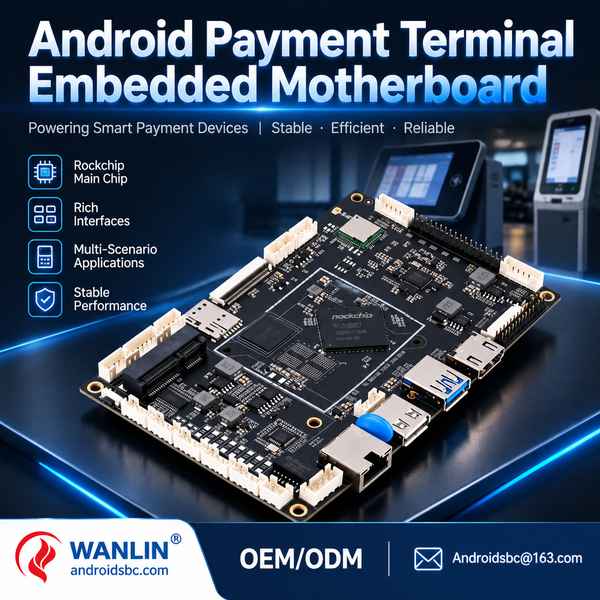
WF-SPT-01 Technical Specifications
| Parameter | AndroidSBC WF-SPT-01 (entry countertop payment terminal build for retail checkout) | Industry Average |
|---|---|---|
| Processor | RK3568 quad-core ARM Cortex-A55 2.0GHz SoC | Older dual-core or quad-core Cortex-A7 SoC |
| Process node | 22nm | Older 40nm process |
| GPU | Mali-G52 2EE | Older Mali-400 or basic 2D GPU |
| Memory | 2GB LPDDR4 | DDR3 512MB or 1GB on competing boards |
| Storage | 16GB eMMC plus TF card up to 128GB | NAND flash 4GB or 8GB on competing boards |
| Display and touch | 5.5-inch 720x1280 MIPI DSI capacitive touch panel with 5-point capacitive touch with glove and wet-finger support | 4.3-inch 480x800 panel with resistive touch |
| Payment and capture | NFC contactless reader, magnetic stripe and IC card slot with secure element | Camera-only QR capture with no scan engine |
| Printer and peripherals | 58mm thermal printer header with 90mm per second output | No printer control header on competing boards |
| Wireless and positioning | dual-band WiFi 802.11 a/b/g/n/ac with Bluetooth 5.0 | Single-band 2.4G WiFi 802.11n with no modem |
| Interfaces | 1 USB Type-C host and OTG, 1 RS232, 1 TTL UART, 4 GPIO, 1 thermal printer header | One USB port and no RS232 |
| Operating system | Android 12 with AOSP baseline and optional GMS | Android 9 or Android 10 on competing boards |
| Power and reliability | 12V DC barrel input with 5V/2A peripheral rail and RTC backup, -10C to 50C operating ambient | No battery management and no watchdog |
All parameters in the table above are measured at 25C ambient. The AndroidSBC WF-SPT-01 (entry countertop payment terminal build for retail checkout) holds the touch panel, the thermal printer, the reader and the scan engine together while running the 72-hour burn-in loop, a configuration that competing single-platform boards rarely document at the top of the temperature window. For India importers sourcing the WF-SPT family, the WF-SPT-01-A variant is the typical configuration for the convenience store counter checkout use case, in a payment terminal footprint with a sustained weekly capacity of 5000 pcs/wk.
Challenges in Sourcing Smart Payment Terminal Android Motherboards for India Buyers
The first problem international market buyers hit is the difference between a sample that works and a configuration that repeats. A board can pass a bench test and still fail in volume if the printer driver, the scan engine mapping and the modem band list were never documented as part of the delivery.
Key handling is the fifth problem. Payment hardware shipped into India has to show how keys are injected, how the secure element is provisioned and how a tamper event is logged, and that documentation belongs in the international market delivery file. The commercial structure is deliberately boring - 200400 boards at a published price, the configuration frozen for the term of the agreement, and the compliance pack reissued whenever the India acquiring partner updates its requirements.
Competitive Comparison: WF-SPT-01 vs Competing Smart Payment Terminal Motherboards
Aan India integrator comparing two boards should compare the delivery file, not the datasheet. One side ships a test report and a compliance set; the other ships a board and a promise.
- vs consumer tablet boards: the WF-SPT family carries a printer control header, a reader antenna reference design and a scan engine UART mapping, none of which exist on a tablet derivative board.
- vs single-configuration boards: twelve configurations share one peripheral contract, so a international market buyer can move from a countertop lane to an unattended kiosk without re-qualifying the printer or the reader.
- vs boards without a firmware plan: signed images, staged OTA groups with rollback and a published maintenance window come standard, where competing boards ship an image and leave the India integrator to manage it.
- vs re-spun designs: the bill of materials is frozen per production lot for the length of the agreement, so the board that passed qualification in international market is the board that ships in volume.
Global Cashless Payment, Smart Terminal and Self-Service Checkout Market Trends
For international market integrators the market signal is simple - contactless and QR now carry the majority of face-to-face volume in India, so the board is specified around the reader and the camera first and the keypad second.
- Countertop tier: WF-SPT-01 covers contactless, IC card, QR and receipt printing in one board, which is the configuration most staffed lanes standardise on.
- Unattended tier: WF-SPT-08 pairs the modem with the printer header and the watchdog for vending, lockers and kiosks where nobody is there to reboot the terminal.
- Flagship tier: WF-SPT-04 adds the larger memory and storage bundle, the customer-facing screen option and the wider temperature window that outdoor and high-throughput formats require.
The India market is large enough to absorb several suppliers and disciplined enough to punish the ones who re-spin boards between lots. Holding the configuration is the strategy, and it is the one AndroidSBC runs for international market.
WF-SPT-01 Application Scenarios
The WF-SPT-01 entry countertop payment terminal build for retail checkout sits inside a twelve-configuration WF-SPT Android motherboard family from AndroidSBC, a Wanlin Manufacturing Group export brand. The WF-SPT-01-A configuration is the typical build for the convenience store counter checkout use case, with printer current profile, scan engine mapping and staged OTA management bundled.
- Convenience and grocery counters: the WF-SPT-07 takes contactless, IC card and QR at the till and prints the receipt in one pass.
- Restaurant and quick-service counters: the WF-SPT-11 runs order entry, payment and kitchen ticket printing on the same board.
- Unattended vending and lockers: the WF-SPT-08 pairs the modem with the printer header and the watchdog for sites with no staff present.
- EV charging and fuel forecourts: the WF-SPT-09 holds the wide input range and the sunlight readable panel through a full outdoor season.
- Transit gates and event entry: the WF-SPT-08 takes contactless payment and prints the entry ticket without a fixed counter.
- Self-checkout lanes: one board drives the main panel, the scanner and the receipt printer, with the customer screen option where the format needs it.
- Hotel and resort reception: card pre-authorisation, signature capture and folio printing on a board that also runs the restaurant terminal.
- Hospital and clinic payment desks: card, QR and insurance capture on a locked-down build with staged OTA and an audit trail.
- Government and municipal counters: tax, permit and fee payment on a configuration held for the length of the agreement.
Partnership Models for international market Buyers
The international market decision is usually commercial rather than technical - whether the partner wants inventory risk, integration depth or brand ownership in India.
- Distribution track: the partner buys the WF-SPT board against a published price list, keeps its own stock, and AndroidSBC supplies the printer profile, the scan mapping and the compliance documents with each lot.
- Integration track: the partner takes the board plus firmware customisation, receipt and language localisation and peripheral validation support, with a joint qualification run at the Longgang factory.
- Private-label track: the WF-SPT board ships under the partner brand with customised boot logo, packaging, enclosure and documentation, on a fixed bill of materials held for the length of the agreement.
The India partner that starts on the distribution track and moves to private label does not re-qualify the board, which is the point of holding one peripheral contract across the family.
Frequently Asked Questions
Does the smart payment terminal board family support an entry countertop payment terminal build for retail checkout?
Answer: Yes. The entry countertop payment terminal build for retail checkout is one of the twelve held configurations, which means the bill of materials is frozen for the length of the agreement rather than re-spun between lots in international market.
Which configurations are available in the WF-SPT family for India buyers?
Answer: AndroidSBC ships twelve configurations including the RK3568 board: value desktop, 4G unattended, face recognition, dual-screen, kiosk, legacy Android 11, portable 4G, outdoor, hospitality, multimedia and legacy Linux builds.
Can one smart payment terminal board drive a touch panel, a thermal printer and a scan engine at once?
Answer: Yes. AndroidSBC validates the panel, the printer and the scan engine together rather than separately, because the combined current draw is what decides whether a terminal survives a shift in India.
What payment scheme certification support does AndroidSBC provide for India?
Answer: AndroidSBC prepares BIS CRS registration with WPC ETA for wireless modules documentation and BIS / WPC conformity files alongside the production order, so the international market acquiring partner receives a file that names the parts on the pallet.
What is the minimum order quantity and the sample lead time for India?
Answer: For international market programmes the practical answer is a sample lot first, a joint qualification run second, and a production slot third, with the compliance file issued at the sample stage.
Is custom ROM, boot logo or pre-installed app development available?
Answer: Yes. Boot logo, custom launcher, kiosk mode and pre-installed applications are all available, delivered as a signed image with a staged OTA plan for the international market estate.
How are firmware updates delivered to aan India device estate after deployment?
Answer: Updates are signed, staged and reversible. The international market integrator chooses the group size, and a failed update returns the terminal to the previous image without a site visit.
What shipping terms does AndroidSBC support for India orders?
Answer: Terms are agreed per programme: FOB Shenzhen for stock configurations, CIF Port of international market for volume lots, and DAP where the international market partner wants delivery to its own warehouse.
Contact AndroidSBC: Start Your WF-SPT-01 Sourcing Conversation
AndroidSBC is taking new India partner conversations for the WF-SPT family now. Send the format, the volume and the certification calendar and the engineering team returns a configuration proposal.
- Email: Androidsbc@163.com
- Export service hotline: +8613261677119
- Website: https://www.androidsbc.com
- Source factory address: Wanlin Group, Building B, Building 1, Beisida Medical Device Building, 28 Nantong Avenue, Baolong Community, Baolong Sub-district, Longgang District, Shenzhen, Guangdong, China
For international market and India buyers the offer is a source-factory relationship: twelve configurations, one peripheral contract, a frozen bill of materials and a compliance file that ships with the pallet rather than after it.